
A world where every organisation has the leadership clarity to move forward, and every person within it has the confidence to lead the way.

Digital accessibility is one of those subjects that most marketing teams understand they should care about and relatively few have made a genuine organisational priority. The reasons for this gap are familiar: competing demands, tight timelines, a perception that accessibility work is primarily technical rather than strategic, and an underestimation of the audience whose experience is shaped by how accessible your digital content actually is. All of these reasons deserve to be challenged, because the evidence is clear that digital accessibility is not a compliance concern sitting at the margins of marketing strategy. It is a dimension of quality, reach, and brand integrity that belongs at the centre of how marketing organisations design and evaluate everything they produce for digital audiences.
Understanding the Full Scope of the Audience
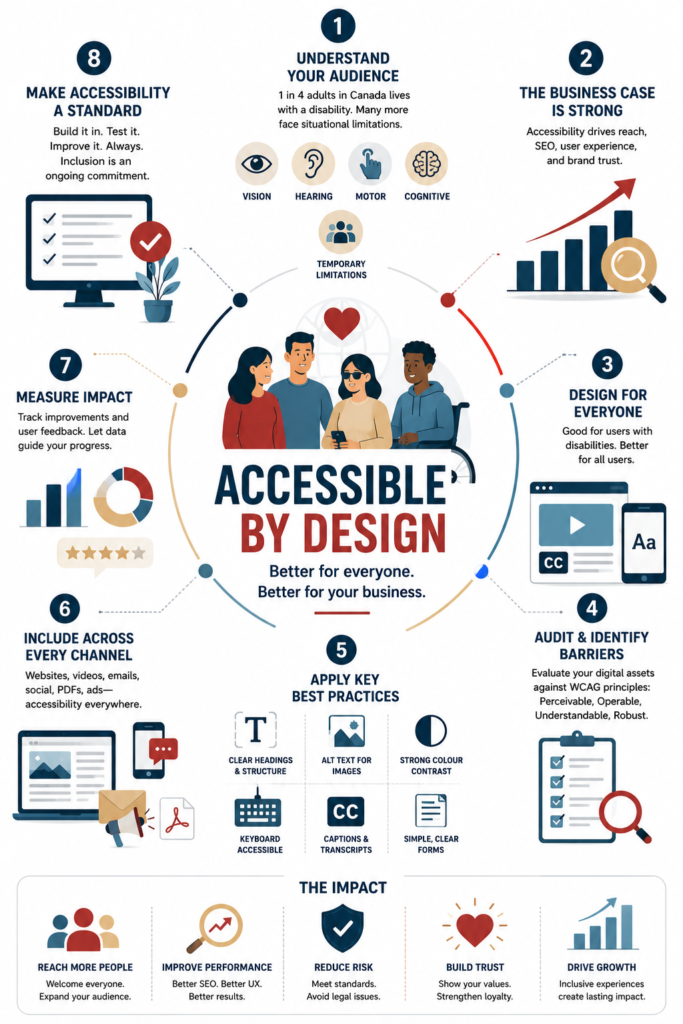
The scope of the audience affected by inaccessible digital content is considerably larger than most marketing professionals intuitively appreciate. Approximately one in four adults in Canada lives with a disability of some kind, and many of these disabilities directly affect how people interact with digital content. Visual impairments affect how individuals use websites and read marketing materials. Hearing loss affects engagement with video content. Motor disabilities affect how people navigate digital interfaces. Cognitive and neurological differences affect how people process and retain information presented in particular formats. Beyond these permanent disabilities, a much larger population experiences situational limitations: a parent holding a child while browsing one-handed, a professional reading on a small screen in a brightly lit environment, a user whose first language is not the one in which your content is written. Designing for accessibility serves all of these people, not only those with diagnosed disabilities.
The Business Case for Inclusive Design
The business case for inclusive digital marketing extends well beyond audience expansion, though that alone would be sufficient justification for many organisations. Search engines are among the primary beneficiaries of accessible content design, because the techniques that make content navigable and interpretable for assistive technologies also make it more navigable and interpretable for search engine crawlers. Clear heading structures, descriptive alternative text for images, transcripts for audio and video content, and logically organised page layouts all contribute to accessibility and to search performance simultaneously. An investment in accessibility is also, in many cases, an investment in organic search visibility.
Accessibility and User Experience
Accessible design also improves the experience for users without disabilities. Pages with clear visual hierarchy, sufficient colour contrast, and legible typography are simply easier for everyone to read. Video content with captions reaches audiences in environments where audio is unavailable or unwanted. Well-structured navigation reduces cognitive load for all users, not only those with cognitive disabilities. The Universal Design principles that underpin web accessibility hold that solutions designed for users with the greatest needs typically produce better experiences for the entire spectrum of users. This is not a theoretical claim. It is borne out consistently in usability research and in the feedback organisations receive when they invest meaningfully in accessibility improvements.
From a brand values perspective, accessibility communicates something important about what your organisation believes about the people it serves. A brand that designs its digital presence with the full range of human diversity in mind is making a visible statement about inclusion that resonates with audiences well beyond those who require accommodations. Research consistently shows that consumers, particularly younger ones, make purchasing and loyalty decisions based in part on their assessment of a brand’s values. A brand that is demonstrably committed to inclusion through the concrete evidence of its design choices is building a reputational asset that extends far beyond the directly affected audience.
Conducting an Accessibility Audit
The practical starting point for any organisation serious about digital accessibility is an audit of existing assets against the Web Content Accessibility Guidelines, which provide a widely adopted framework for evaluating accessibility across four primary dimensions: perceivability, operability, understandability, and robustness. An audit typically reveals a range of issues spanning from relatively simple fixes, such as missing alternative text on images or insufficient colour contrast ratios, to more structural concerns involving navigation architecture, form design, or multimedia content. The audit findings should be prioritised and addressed systematically, with the highest-impact issues receiving attention first and accessibility standards integrated into the production process for all new content going forward.
The reframing that makes accessibility a genuine marketing priority rather than a compliance afterthought is ultimately simple: it is the recognition that accessibility is a dimension of quality, and that quality is not partial. A digital presence that works beautifully for some users and fails others is not a high-quality digital presence. It is a selective one, and in a competitive marketplace where customers have choices, selectiveness about who your content serves is a strategy with a ceiling. The brands that invest in removing barriers from their digital experiences are not simply doing the right thing, though they are doing that. They are also building a more complete, more professional, and more commercially effective presence than the one they had before.