
A world where every organisation has the leadership clarity to move forward, and every person within it has the confidence to lead the way.

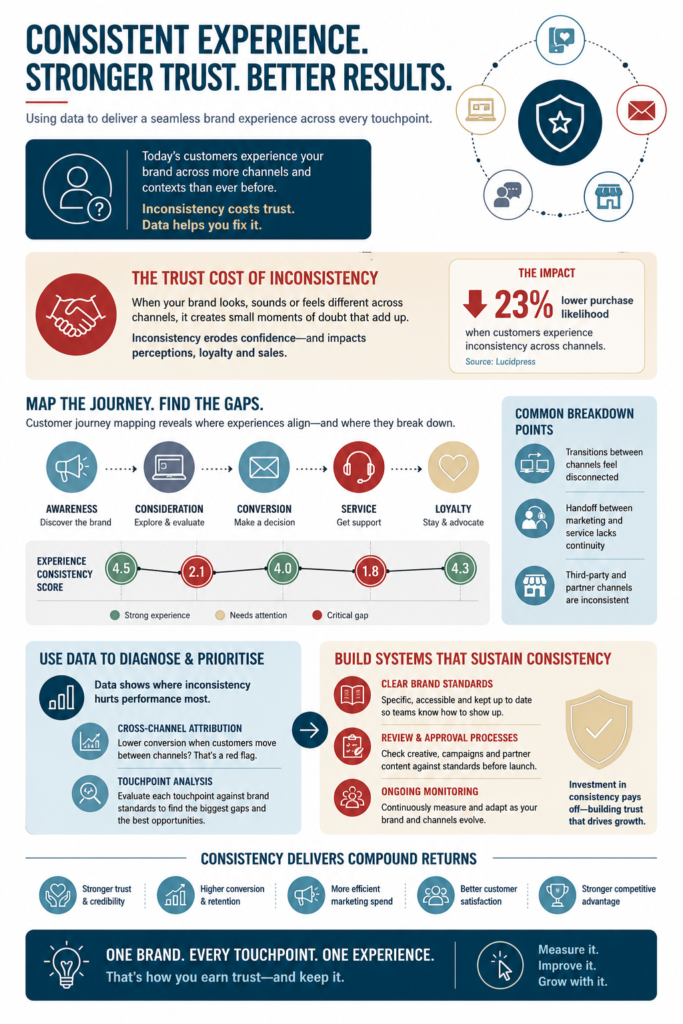
The average consumer today encounters a brand across a more diverse array of channels and contexts than at any previous point in the history of marketing. A customer’s experience of a brand might include a social media advertisement that reaches them during a morning commute, a website visit from their laptop during a lunch break, an email in their inbox that evening, and a review they encounter when considering a purchase on a marketplace platform. These touchpoints are often managed by different teams, produced by different agencies, and optimised for different objectives. The result, in many organisations, is a brand experience that varies enough across channels that a customer who encountered the brand for the first time in each context might not immediately recognise that they were dealing with the same organisation. This inconsistency is one of the most common and most costly problems in brand management, and data offers the most reliable tools available for diagnosing and addressing it.
The Trust Cost of Inconsistency
Consistency in brand experience is not primarily an aesthetic concern, though it has an important aesthetic dimension. It is fundamentally a trust concern. When a customer encounters a brand that looks, sounds, and feels the same across every interaction, that consistency communicates something important: that the organisation is coherent, reliable, and in control of its own presentation. When that same customer encounters a brand whose tone is warm and accessible on social media but formal and distant on its website, whose visual identity shifts significantly between digital and print contexts, or whose service experience bears no recognisable relationship to the values communicated in its advertising, the inconsistency creates a small but cumulative erosion of confidence. The customer cannot necessarily articulate why the brand feels less trustworthy, but the experience of inconsistency has a measurable effect on their perception and, over time, on their purchasing behaviour.
Mapping the Customer Journey
The diagnostic starting point for addressing brand consistency problems is customer journey mapping: the practice of systematically documenting every touchpoint at which a customer might encounter the brand and evaluating the experience at each point against a consistent standard. A well-constructed customer journey map begins with the moments of initial awareness, how the customer first discovers the brand, and follows through to ongoing loyalty and advocacy, charting the brand experiences along the way. The map reveals not only where inconsistencies exist but where the most consequential brand interactions occur: the moments where customers make significant decisions about whether to engage more deeply with the brand, and where inconsistency is therefore most costly. Organisations that have never conducted formal customer journey mapping frequently discover significant gaps in their understanding of how their brand is actually experienced by the people they are trying to reach.
The points at which brand experience most commonly breaks down in multi-channel environments fall into several recurring patterns. Transitions between channels are particularly vulnerable: the customer who responds to a brand’s social media advertisement and clicks through to a website that feels visually and tonally disconnected from the advertisement that brought them there is experiencing one of the most common forms of brand inconsistency. The handoff between marketing and service is another common failure point: the brand voice cultivated carefully in marketing communications often disappears the moment a customer contacts the support team, whose communications are frequently governed by separate guidelines or none at all. And third-party distribution channels, marketplaces, and retail partners frequently represent zones of brand experience over which the brand has limited control and insufficient visibility into what customers are actually experiencing.
Cross-Channel Attribution as a Diagnostic Tool
Cross-channel attribution data, which tracks how customers move between different brand touchpoints on their journey toward a conversion or other desired outcome, is among the most useful data sources for identifying consistency problems. When attribution analysis reveals that customers who encounter the brand first through one channel and then through another convert at significantly lower rates than those who remain within a single channel, this is often a signal that the transition between those channels involves a jarring discontinuity in brand experience. Touchpoint analysis, which evaluates the quality and character of the brand experience at each individual interaction point against a common framework, complements attribution data by revealing where specific channels are delivering brand experiences that diverge from the intended standard and where investment in consistency improvement will have the greatest commercial impact.
Identifying brand inconsistencies through data is only useful if the organisation has the governance structures and operational systems to address them. Brand consistency at scale requires documented brand standards that are specific enough to guide execution across different teams and contexts, accessible enough to be routinely consulted rather than stored and forgotten, and regularly updated to reflect the evolution of the brand and its operating environment. It also requires internal processes for reviewing new creative work, channel strategies, and partner-produced materials against those standards before they are deployed. Organisations that invest in these governance structures typically find that the cost of maintaining consistency is considerably lower than the ongoing cost of managing the customer confusion and trust erosion that inconsistency produces, making it one of the highest-return brand management investments available.
Consistency as Competitive Advantage
In a market where most brands struggle to maintain coherence across their growing array of customer touchpoints, genuine brand consistency is itself a competitive differentiator. Customers can feel the difference between a brand that has a unified and well-executed experience across channels and one that does not, even when they cannot articulate what they are responding to. That felt difference produces real commercial consequences in the form of higher conversion rates, stronger advocacy, and greater resilience when individual service or product experiences fall short of expectations. Data provides the means to identify where consistency is breaking down and to measure the impact of improvements over time. The organisations that use these tools to build genuinely coherent brand experiences across all customer touchpoints are building one of the most difficult-to-imitate forms of competitive advantage available in the current marketing environment.